

Nuts & Napkins
Exposing the Absurd Checklist and Executive Delusion Behind Forbes Five-Star Hotel Standards.

| Estimated Reading Time: 7.86 Minutes
Content Warning: This article exposes manufactured luxury, executive delusion, and features an absurdly excessive number of napkins. Proceed with a strong cocktail.
OMG, we just got our fifth Forbes Star!
Pop the champagne, set off the fireworks, the managers are high fiving like their stock options just doubled, all for an award that only cost a hundred grand and counting.
Now it’s time to hit the Forbes Accolades Store and order us some plaques. (Managers and executives break dancing.)
That’s the fantasy version, the loop running in the minds of executives as they justify the six figure plus cost.
A burden that ultimately lands on staff, left to execute impossible and often biased standards.
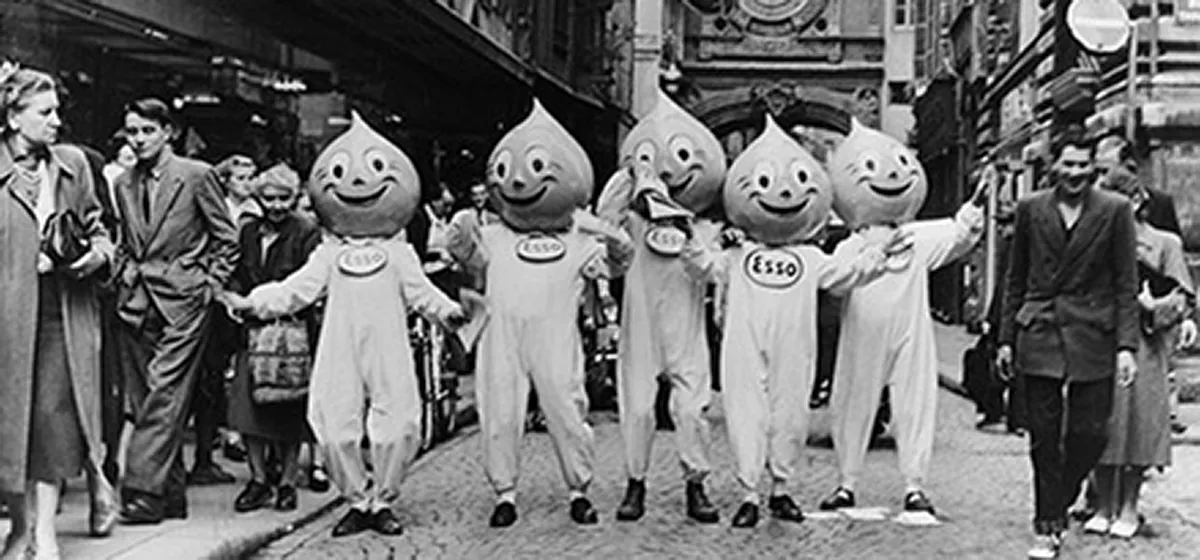
‘happy’ The Oil Drop Man | Image by Exxon/Moble
I. The Delusion of Grandeur
Here’s where the confusion begins. Forbes Media doesn’t actually own the Forbes Travel Guide. Confused?
Yeah, me too at first.
Back in 1958, it wasn’t Forbes at all, it was Mobil Oil Corp. (Happy motoring campaign)
The company wanted people to drive more and buy more gas, and figured that if they published a list of destinations worth visiting, families might pack the car and hit the road. By 1960,
Mobil had created the now famous five star rating system for hospitality.
After that, the guide got passed around. In the seventies it was published by Rand McNally.
In the eighties it went to Simon & Schuster. In the nineties Fodor’s had a turn.
By 2001 it was spun off into its own company with ExxonMobil still in the background.
Then in 2009, ExxonMobil licensed the brand to the Five Star Ratings Corporation, run by Jeff Arnold, the guy who founded WebMD.
This is the moment Forbes Media licensed the rights to its name, FORBES, to be used with the travel guide.
My guess is they didn’t think Mobil sounded like luxury, so they struck that deal,
and that’s how the Mobil Travel Guide became the Forbes Travel Guide.
The printed books ended in 2011, and since then it’s lived only online.
To put it simply: the only thing Forbes Media provides is their name and prestige, for a fee, creating the illusion that the Five Star Ratings Corporation is as prestigious as Forbes Media itself.
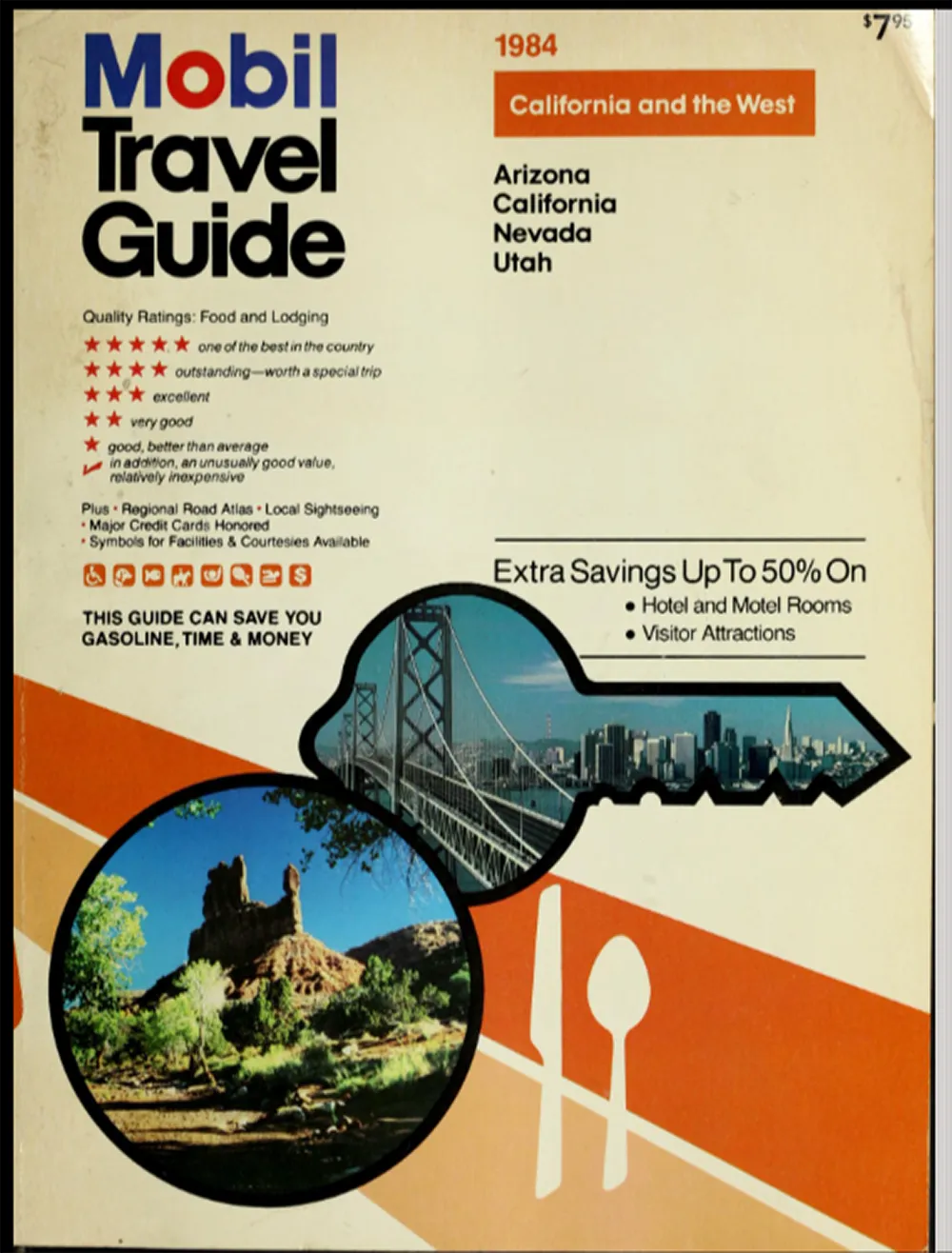
Moble Travel Guide 1984 Web | Image by Moble Travel Guide 1984
The Branding Deception
Even though they’re separate companies on paper, Forbes Travel Guide content now appears on Forbes.com under contributor labels.
It’s presented in the same layout and tone as Forbes Media’s own reporting, which makes the separation almost impossible to see unless you’re looking for it,
which I was.
The entire structure is a masterful bit of brand building: the licensing arrangement ensures articles about the ratings appear on the prestigious Forbes Media platform, creating a sophisticated illusion of objective editorial authority.
It’s an illusion the executives want to believe: they pay the fee and convince themselves they’ve bought real credibility.
Like lipstick on a pig
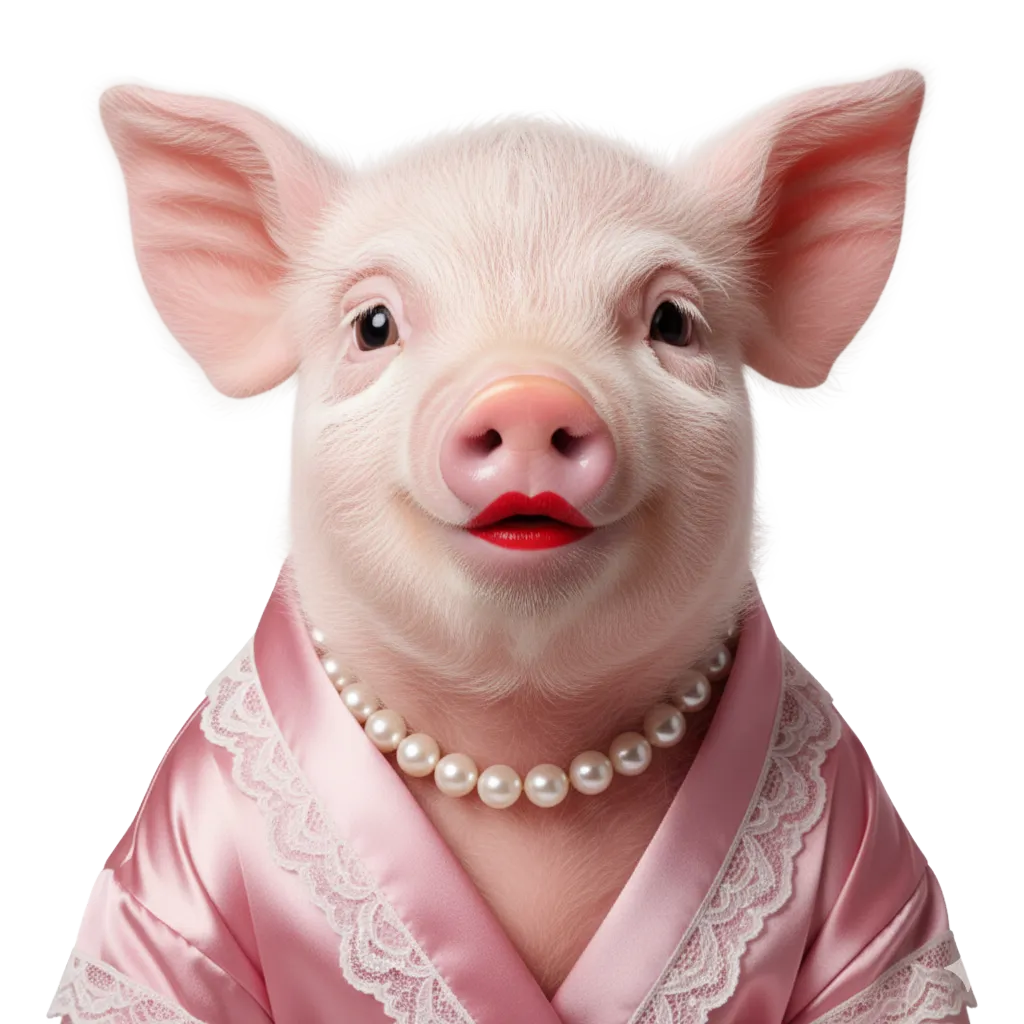
Lipstick On A Pig |
II. The Cost of Access
According to Forbes Travel,
“You cannot buy a Star,”
and technically that’s true.
But let’s be honest: you also can’t get in the room without making a purchase.
Forbes states on their site:
“For properties that we elect to Star Rate, we offer the option of joining our Partnership Program, which provides transparency into the Star Rating process and access to our exclusive Partner community. Partners receive valuable benefits including a complete list of FTG standards, a full report of their annual Rating inspection results, and policy privileges such as cycle selection and remedy periods.”
So how do they decide who gets “elected” to be Star Rated?
I have no freakin idea.
But if you pay to join that Partnership Program, they’ll absolutely come to your property and inspect it.
And just like the quote says, you gain access to the full checklist, your scoring results, and a chance to fix whatever kept you from passing.
And I’m guessing it’s not cheap. They have to send an inspector to stay at the hotel, go to the restaurant, lounge, and spa, and audit you.
Then you get the results which you likely will not pass on your first or second attempt
(you need to get: Five Star – 90% and Over; Four Star – 82% and Over; Recommended – 72% and Over).
And only if you’re in the Partner Program do you get the full breakdown of standards and results (in other words, the cheat sheet), along with training on how to fix it.
Rinse and repeat. Every time you don’t hit the star goal.
And I promise you, they’re in no hurry to give those stars away. I mean, you can’t technically buy a star, but you can buy endless training.
For a hundred grand and counting, you too can “earn” your precious stars.
And yet, some of the top properties in the world, like Santiago de Alfama in Lisbon, currently TripAdvisor’s #1 Luxury Hotel on the planet, don’t appear anywhere on the Forbes Travel Guide list.
Even more ironic, Passalacqua, Lake Como,, which Forbes Media itself has ranked among the “Best Hotels in the World,” also isn’t rated by Forbes Travel Guide.
Oversight. Translation: they didn’t pay the cover charge.
A Grain of Truth
Forbes has a lot of standards and as a long-time F&B’r I can only speak for the restaurant and lounge ones.
And to be fair, most of those standards make sense.
They’re basic hospitality.
A few of them are outdated. Some are biased. And a handful are so ridiculous they actually get in the way of good service.
The standards alone aren’t the problem.
The problem is when management treats them like scripture and expects everyone else to join the cult.
That’s when the pursuit begins, and the performance takes over.
“I fucking hate Kool-aide”
III. The Pursuit and The Performance
Once management starts chasing Forbes Stars, real guests fade into background noise,
because the only guests that matter are the Forbes inspectors.
Every one top or deuce could be them, so it has to be perfect.
Management paranoia at its finest. Server paranoia right behind it.
“Oh my God, She might be an inspector. She asked me what dressing was in the Caesar salad.”
At the hotel I was working in, they operated like a hybrid of the CIA, FBI, and Sherlock Holmes, obsessively trying to identify the mystery person.
They would cross check hotel check ins against restaurant, lounge, and spa reservations.
They’d build little suspect lists and flag names. Every outlet would report their activity. Every server was expected to note whether a guest felt like a Forbes inspector.
We weren’t in hospitality anymore. We were in counterintelligence.
And if you think that sounds dramatic, let me introduce you to the rehearsal phase.
Exit stage left:
That’s when management started running practice audits.
Full simulations where hotel managers would sit in the lounge pretending to be inspectors while we pretended not to know them.
We were basically running CIA sting operations in aprons.
They would order drinks, claim fake allergies, fire off a barrage of scripted questions.
Nothing like a real guest would ever do.
Meanwhile, real guests were second class citizens.
It’s not that the practice was a bad idea.
But the auditors should have had common sense and not be there during busy moments.
I would have loved it if a real Forbes inspector had walked in during one of these drills while we were trapped in a fake 20 question game about gluten.
We were not serving people anymore, we were acting.
Then came the script changes.
One of the most common deductions we got was for not using the guest’s name. Fair.
Using someone’s name once is polite. But one overzealous manager decided we should say it three or four times in every interaction.
I don’t even say my friends’ names that much.
Once is hospitality. Three times is creepy stalker territory.
They just want a cocktail, a clean seat, and a little peace.
Not a server whispering their name like “Carol Ann” from Poltergeist.
I’m sure Forbes tells their “Partners” earning Stars will lead to more business.
Why wouldn’t they?
Their whole “luxury” game depends on hotels believing this.
Management buys it like gospel, convinced prestige equals profit.
Maybe to a few, but real guests aren’t asking,
“Excuse me can you make sure there are at least 16 napkins on the table?”
Official Forbes Travel Guide Standards (Observed)
1. IF A SNACKS ARE SERVED NAPKINS ARE PROVIDED.
2. IF PROVIDED, NAPKIN ARE MADE OF LINEN OR COTTON.
THE LUXURY OF WARM NUTS
So apparently luxury now means snacks.
And not just any snacks, high quality snacks.
At the Horse Racing Lounge we served warm mixed nuts, seasoned with paprika, a touch of cayenne, and brown sugar.
Served warm like all nuts should be, and honestly, they were sexy.
Forbes also insists they be served with their own napkin.
Not the coaster napkin.
Not the drink napkin.
A dedicated Nut Napkin. I called them Nut Naps.
And God forbid a single cashew leaned over the edge of the bowl, that would not be considered “luxury.”
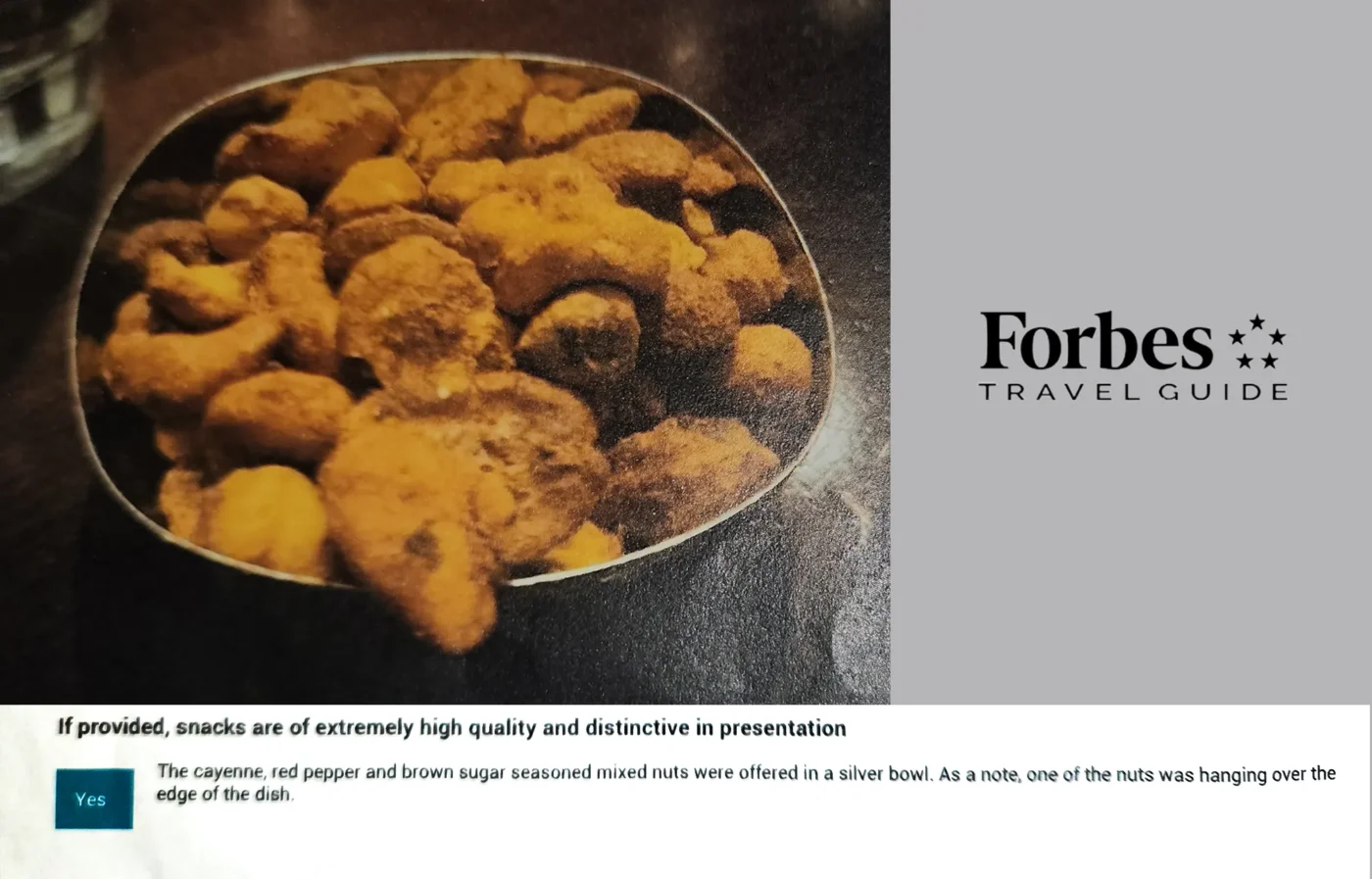
Hanging Nut |
NAPKIN PROTOCOL: A CASE STUDY IN MANAGED INSANITY
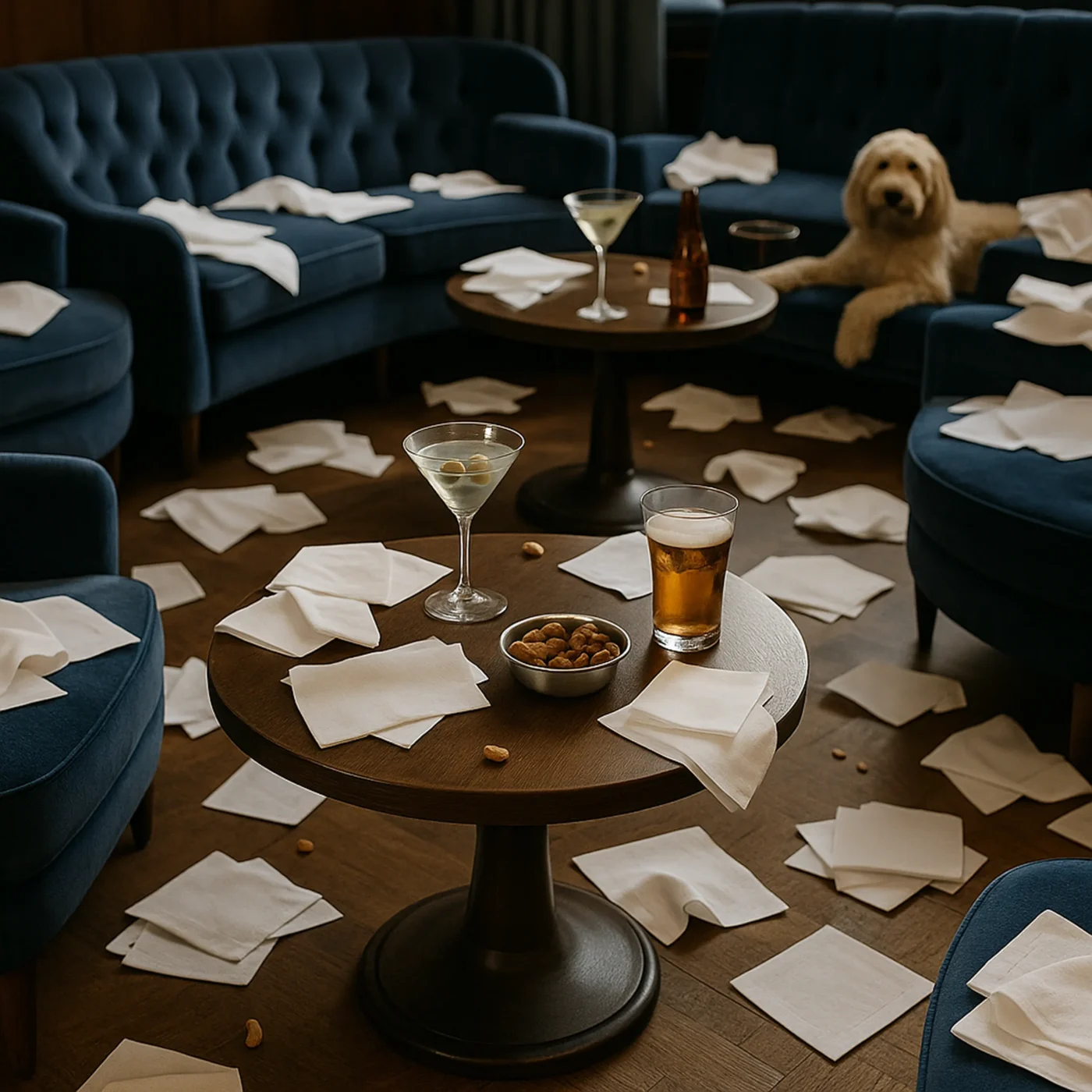
FTG’s napkin standards were their own form of madness. First rule: every drink must have a coaster.
We used to have nice thick imprinted ones, then FTG made us switch to little fabric squares because apparently nothing implies luxury like linen squares.
Then comes the snack rule. FTG requires lounges to offer snacks, so for every person at the table you have to lay down a napkin under the snack.
Four guests means four napkins.
Then they order cocktails, that’s four more.
Then they ask for water, which technically we were told not to offer (another story for later), but that’s four more.
So now we’re at twelve napkins for four people before they’ve even ordered food.
Then they decide to share an appetizer.
Four more napkins.
That’s sixteen napkins for one four top.
I stopped being a server and started dealing linen like I worked at Caesar’s Palace.
Some of their rules are painfully specific, napkin placement, garnish angles, scripted greetings, yet the most basic human courtesy doesn’t even register:
Hydration:
Some of their rules are painfully specific, napkin placement, garnish angles, scripted greetings, yet the most basic human courtesy doesn’t even register: offering water.
I’ve been in restaurants over twenty years. Offering water when someone sits, especially if food’s involved, especially in ninety degree Charleston humidity, is automatic.
It’s not even a service standard.
It’s a human standard.
But at the horse racing lounge, I was told not to offer water unless the guest specifically requested it.
Why? Because every second had to go toward hitting Forbes checklist items. Water wasn’t on the list, so it wasn’t a priority.
**Hydration didn’t earn points. Nuts and napkins did.**
Nova At The Lounge Web | Image by Nova At The Lounge
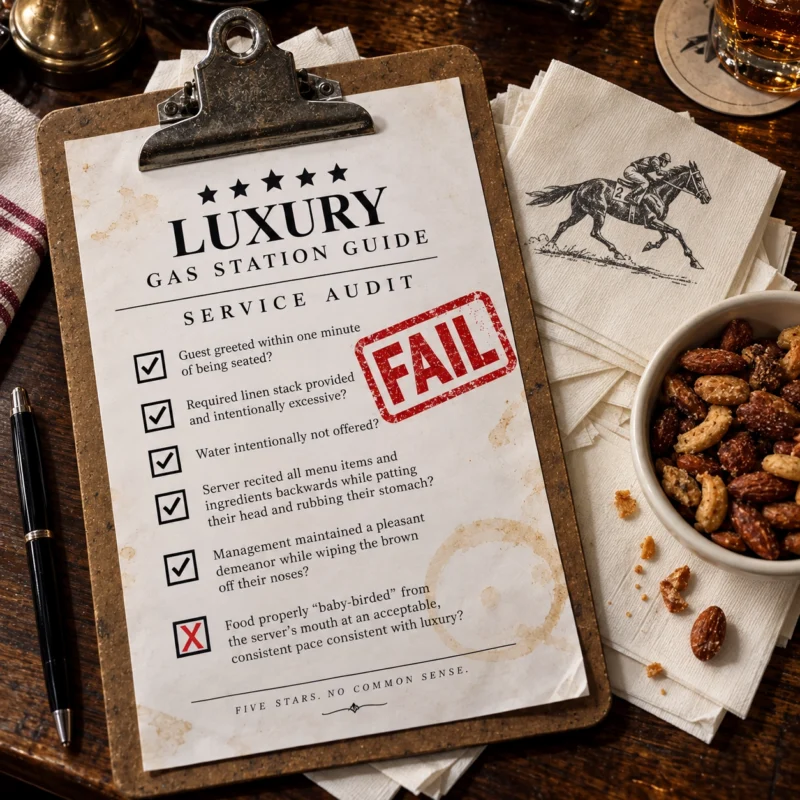
The Audited Life: A Satirical Checklist
Field Protocol (Unofficial Annex A)
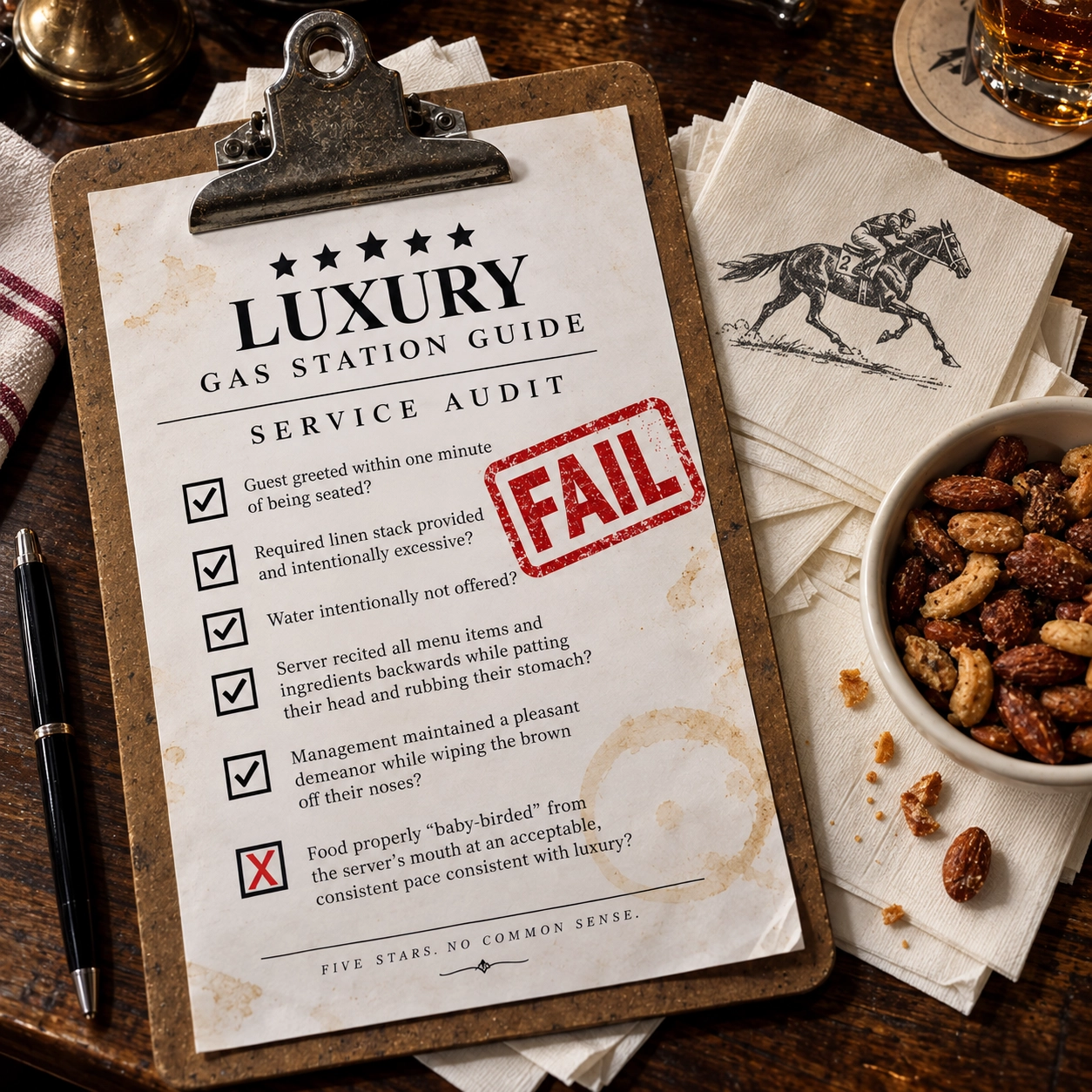
Here’s what it felt like they were auditing:
- Was the guest greeted by a service professional within one minute of being seated?
- Was the guest provided with the required linen stack and intentionally offered no water?
- Did the server recite all menu items and ingredients backwards, while patting their head and rubbing their stomach, with perfect spelling?
- Was the hamburger properly “baby-birded,” presented from the server’s mouth at a consistent pace consistent with luxury?
- Did the server maintain a genuinely joyful appearance, conveying through their eyes a deep, personal connection to my dining experience?
IV. The Racket’s True Cost (Final Verdict)
There’s a difference between having standards and being standardized.
The pursuit of the Forbes Star ultimately costs a fortune, destroys staff morale, and replaces genuine service with scripted, bizarre rituals. We traded basic human courtesy (like offering water) for an antiquated checklist obsessed with linen and garnish angles.
The absurdity of this made up system is confirmed by the top hotels and restaurants around the world who do not partake.
I didn’t even realize all of this until I started doing research. But now that I do, I’m convinced: if most people actually knew how this game worked, they’d stop giving it so much credit.
This whole charade is an ego trip, a consulting service bought in by owners and management, masquerading as an objective authority.
They turn us into robots and scrape away our souls, all to win a validation that ultimately means nothing. It’s just a lavish disguise.
There are legitimate stars and reviews out there, and Michelin is one of the most respected, as it should be.
They don’t have a Partnership Program, and they don’t sell executive deals to the companies buying in, literally and figuratively.
Even TripAdvisor, while guest driven and not perfect, is a better, more honest gauge.
luxury noun
Webster defines luxury as :
“Something adding to pleasure or comfort but not absolutely necessary.”
But according to Forbes?
It’s all about the Nuts & Napkins.

Trending
Weighing Culinary Diplomas Against Kitchen Battle Scars
“I Was Wrong, Kinda”
Fear And Loathing In Woody Creek
Nuts & Napkins

The Manager On Duty
Non-Slippin In The Kitchen

The 5 Best Cities for Restaurant Workers to live in 2026
Suing The System

Hooking Up With Coworkers
Serving Philanthropy with a Side of Santo