


What Happens When No One Pays?
The Radical Hospitality of Love Burn

| Estimated Reading Time: 6 Minutes

“The customer is always wrong.”
At least, according to NYC Deli, a beloved theme camp at Burning Man and its regional counterparts.
An elaborate and wildly generous operation, the camp delivers an authentic New York–style deli experience to lines of lunch-awaiting burners, serving stacked sandwiches, bagels, hot coffee, and a heaping side of “sassy service.”
They aren’t dining alone.
Across the playa, countless theme camps turn food into gifts, feeding the week-long city not for profit, but for pleasure.
It’s generosity at scale. Ironically, the community is abandoning that all-too-familiar corner-store transaction and supplementing it with a dinner party.
Asking your neighbor for sugar is normalized once again.
The Bread
Laying the Foundation: Infrastructure Disguised as Abundance
“Ask them if they want left- or right-handed onions,”
A camp member whispers from in front of the counter, pre-service at this year’s Love Burn.Those around me laugh, latex gloves enveloping our hands as we prep for service.
This is NYC Deli, a recurring theme camp at Burning Man and its regional offshoots, where the customer is always wrong, and there is no reprimand for letting them know just that.
Whiteboards scrawled with menu items sway in the wind while DJs spin, dancers perform acrobatics, and tip jars are pranced up and down the line (filled only with trinkets, of course).
It is less transactional than performance art; hospitality as improv and a smeared bagel as a prop.
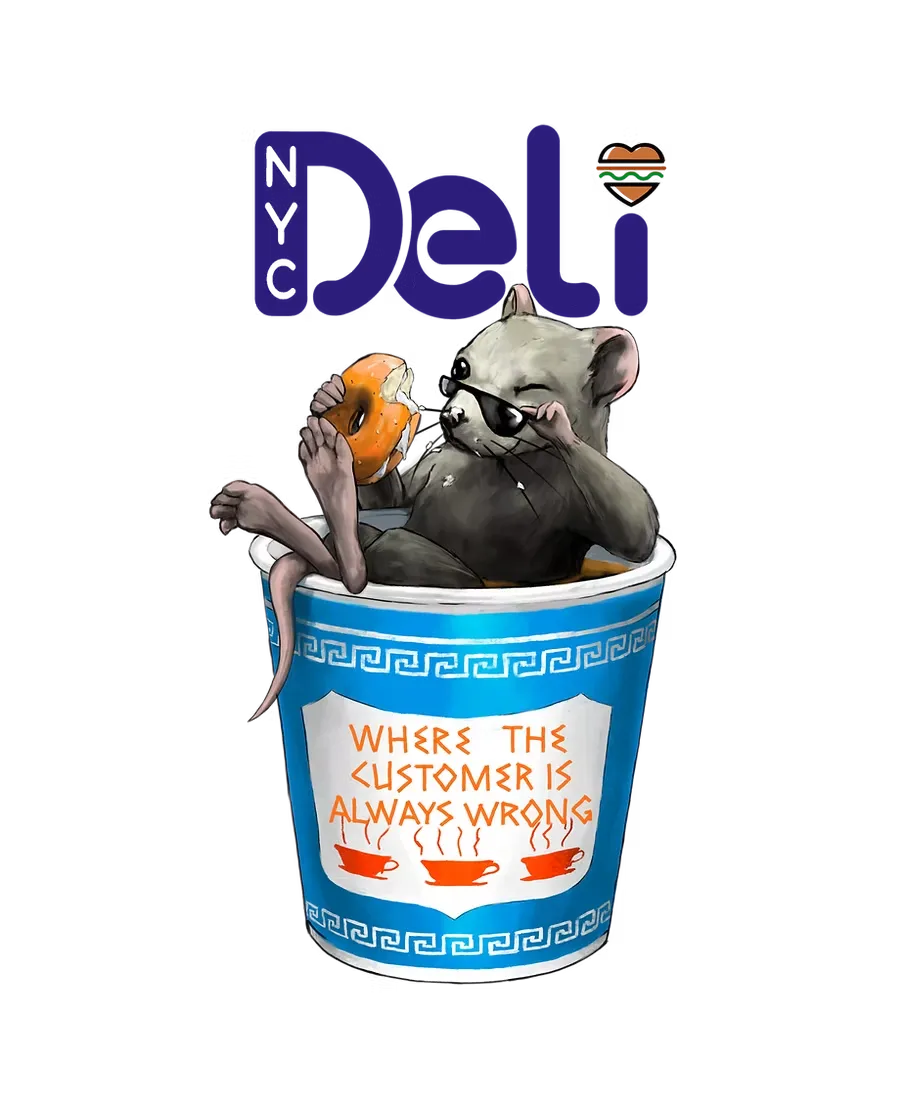
NYC Deli Theme Camp Love Burn 2026 | Image by Hospitality as performance art: The NYC Deli mascot at Love Burn 2026.
Modeled after the classic New York corner deli, equal parts efficiency and attitude, the camp serves up stacked sandwiches.
The hungry, eager line, typically spanning around the block, goes down an assembly line, selecting their choice of bread, condiment, cheese, protein, and veggies, all while being lightly berated and sassed.
Think: Seinfeld Season 7, Episode 6, “The Soup Nazi.” After days of camping, it feels like the meal of a lifetime, even if you have to endure a little theatrical scolding to earn it.
The “sassy service” is heavily ritualized. Customers who get it, get it, and they play along. Others are teased even more so.
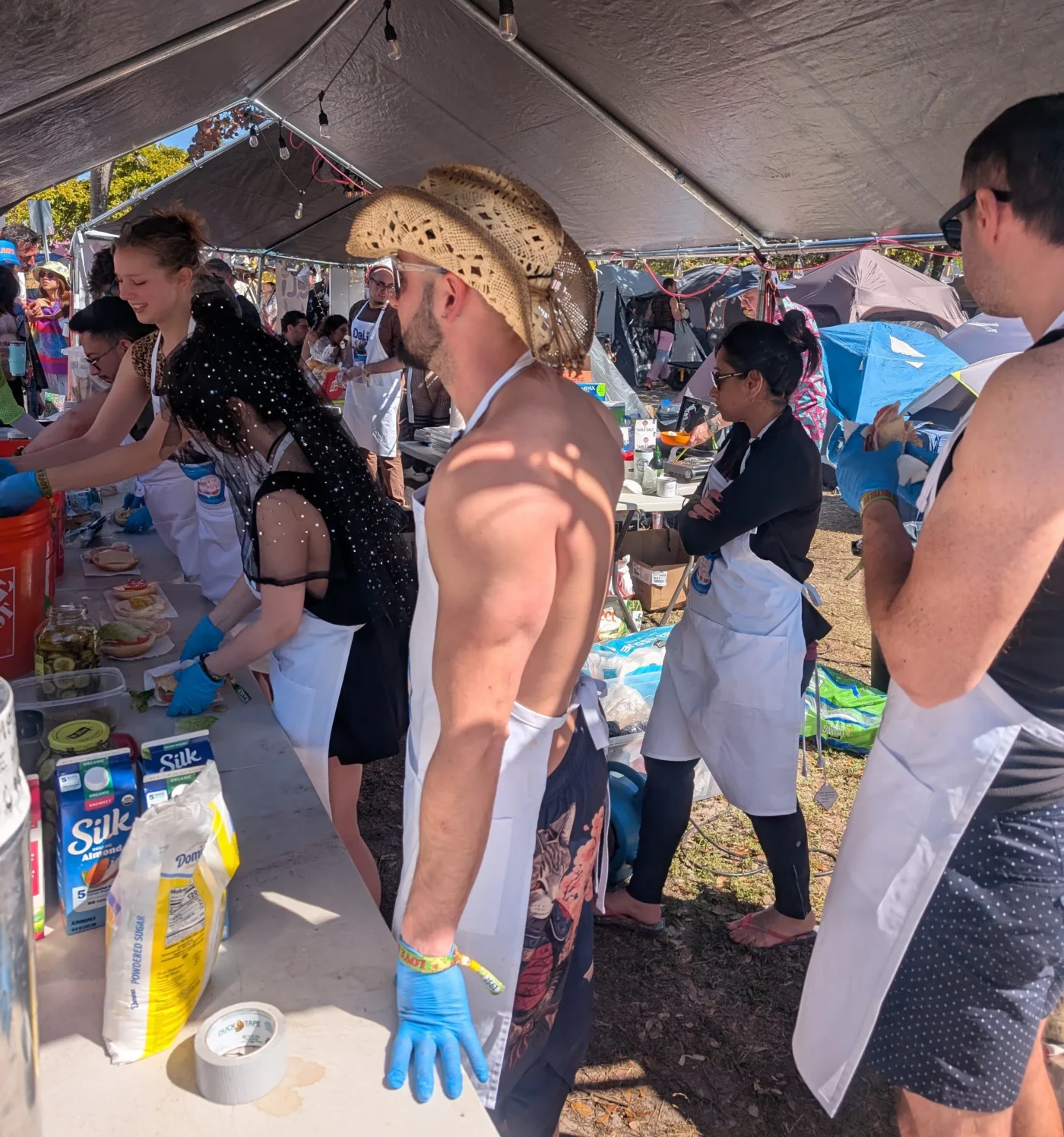
nyc-deli-crew-service-love-burn-2026 | Image by Behind the scenes with the NYC Deli crew: The intense, coordinated labor required to gift hundreds of sandwiches at Love Burn.
The deli workers move with a sort of choreography. Everyone understands that the bit is as important as the bite. In a community built on radical self-expression, their particular expression just happens to involve yelling at you about onions.
Beneath the punchlines, there is an operation that would rival a small restaurant.
What appears effortless is the result of months of planning. Fundraisers are held, ingredients are budgeted for, sourced, and transported onto the grounds.
Coolers are packed with precision, and the refrigeration is rigged to survive the heat.
And, when the day comes, camp members wake up bright and early on their shift days to brew the vats of coffee and prep vegetables much before a line forms.
The illusion is abundance: Home Depot buckets full of shredded lettuce and bins of sliced bread. The reality is labor, coordination, and devotion. In a place where nothing is bought and everything is given, the sandwich is never just a sandwich. It is infrastructure. It is offering. It is proof that someone woke up early so you could eat.
NYC Deli isn’t alone in its ambition.
Epicure, helmed by a Michelin-starred chef, roasts prime rib, shucks oysters, smokes brisket, and serves whole fish as if the playa were a white-tablecloth dining room.
Cheesus Crust arrived at Love Burn this year with nearly $10,000 worth of sashimi imported from Japan, alongside their cult-favorite grilled cheese service. Across the community, camps invest staggering time, money, and energy into feeding others — an act of generosity expressed through culinary devotion.
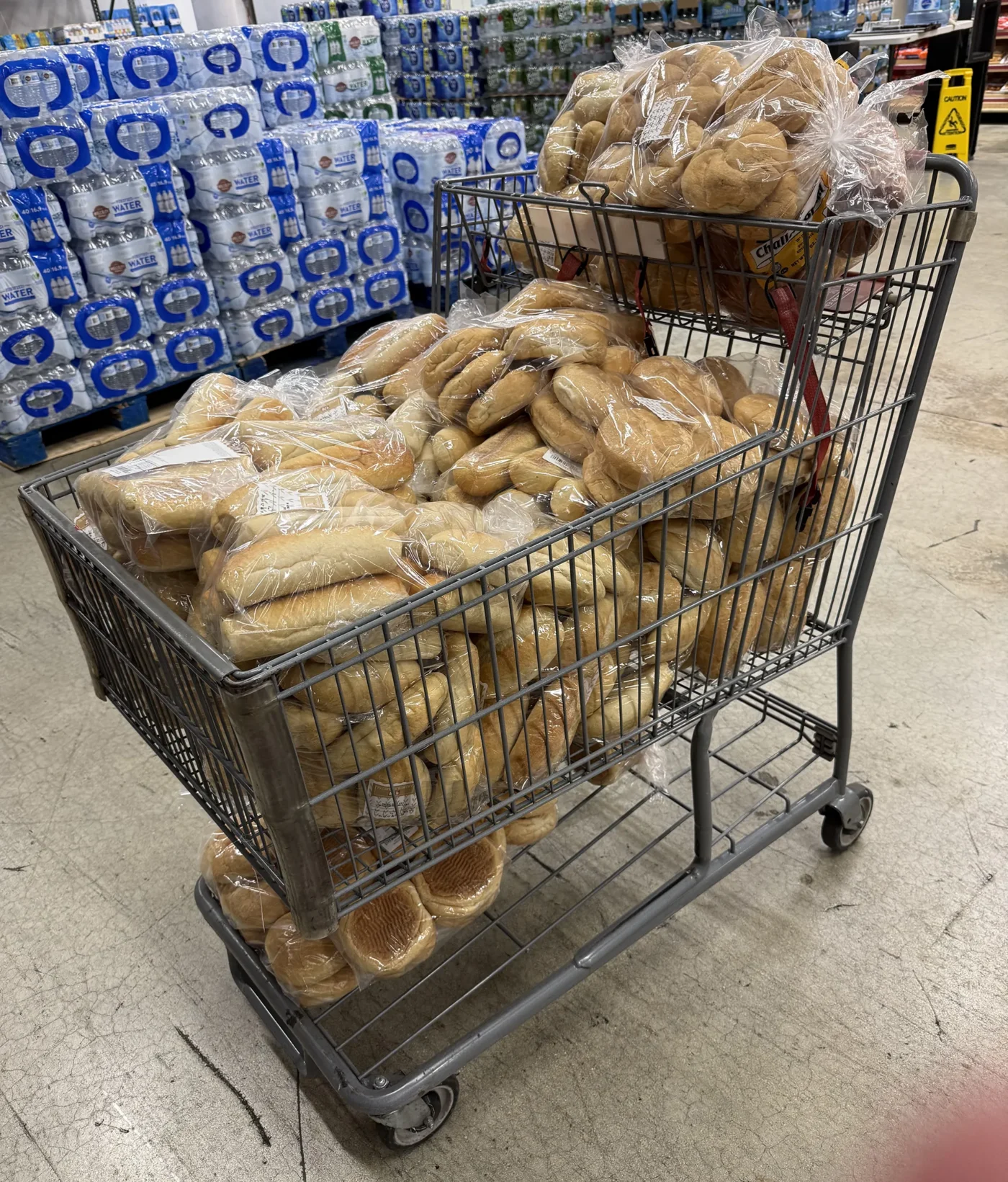
nyc-deli-bread-logistics-love-burn | Image by Scaling the gift economy: A single shopping cart barely contains the foundation for a day's worth of free sandwiches at NYC Deli.

The Meat
Notes of Substance: Power, Labor, and the Rewriting of Exchange
At Burning Man and its regional counterparts like Love Burn, money is not merely discouraged. It is structurally removed.
The community runs on a gifting economy, an experiment in radical generosity where goods and services are offered freely, without expectation of compensation or exchange.
Food, in this ecosystem, becomes something different.
In the default world, a sandwich is priced. It reflects ingredient cost, labor, rent, branding, and markup. It passes across a counter in exchange for currency, and with it comes a defined power structure: customer and server, buyer and seller, tipper and tipped.
Even in the most beloved neighborhood restaurant, hospitality is tethered to transaction.
At a burn, there is no customer. There are only participants.
The absence of money creates a subtle but radical psychological shift. Without a financial exchange, the expectation of deference dissolves.
You cannot demand perfection from someone who is feeding you for free. You cannot weaponize Yelp.
The person handing you a bagel is not obligated to smile; they are choosing to be there.
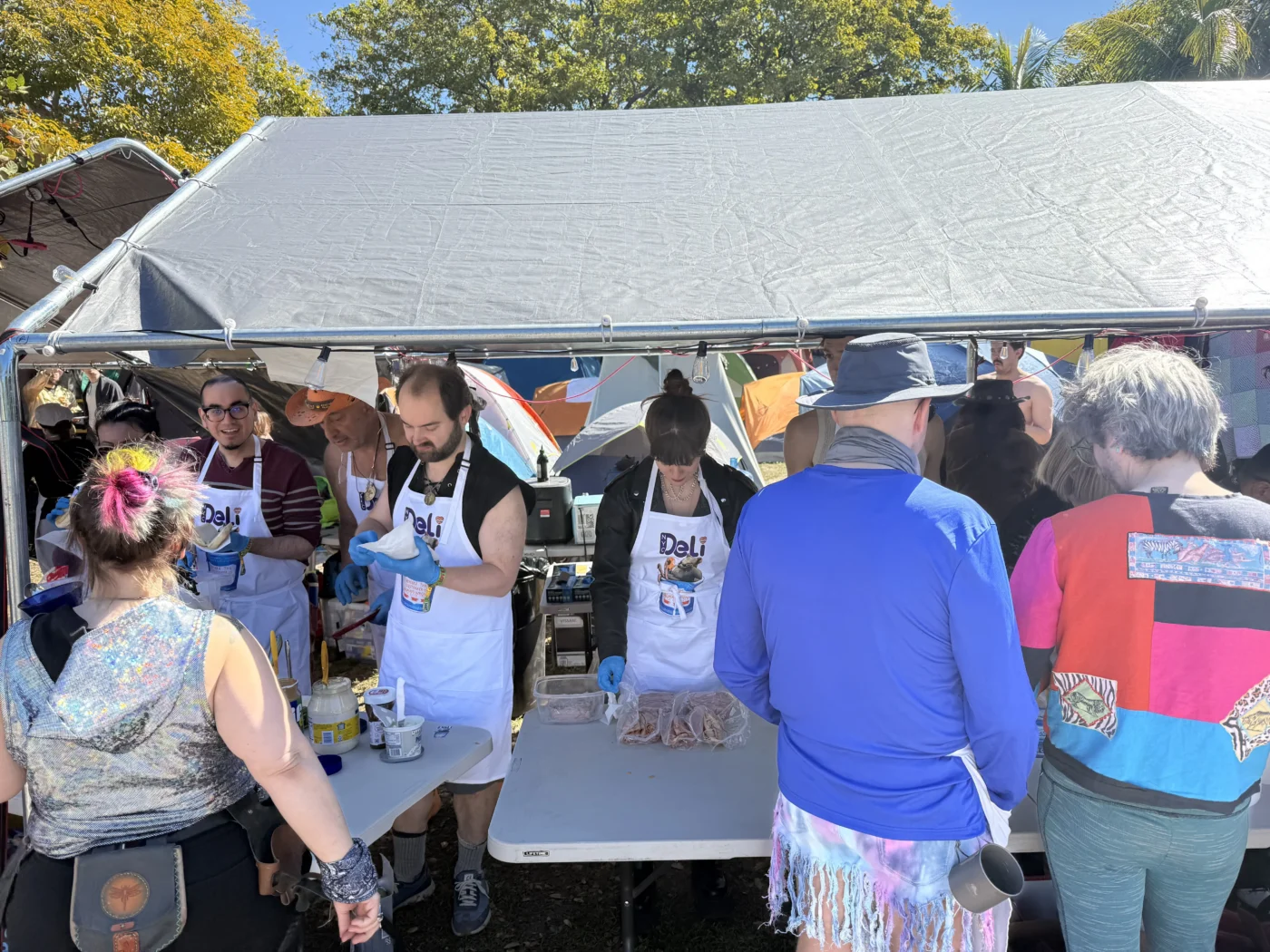
Camp Nyc Deli | Image by Camp Nyc Deli
And yet, labor remains. Time is still spent.
Ingredients are still purchased long before arrival.
Someone still wakes early to brew coffee. The difference is intention.
Effort is offered as a contribution, not a survival. The sandwich is not a commodity; it is a gift.
This reframes “service” entirely.
In traditional hospitality spaces, service is often about managing power. It is emotional labor layered atop physical labor.
Tip culture further complicates the equation, turning kindness into a strategy and friendliness into potential income.
The sad truth is that a server will perform warmth because their rent may depend on it.
At Burning Man, performance remains but is redirected.
The bit at NYC Deli is not about appeasing a paying guest.
It is about creating a shared joke. The teasing, the mock-inspection, the shouted onion inquiries — they do not reinforce hierarchy. Rather, they dissolve it.
What emerges is not service, but community as spectacle. Hospitality without hierarchy. A dinner party scaled to thousands, where the host might yell at you and you thank them for it, genuinely.
In the default world, when you buy a sandwich, you’re purchasing a product. The satisfaction comes from consumption: you paid, you received, transaction complete. The emotional exchange ends there. It’s economic.
At Burning Man, because there’s no money exchanged, the sandwich isn’t fulfilling a contract. It’s fulfilling a relationship. When food is no longer a commodity, it becomes connective tissue.
The Cheese
Domesticity at Scale: A Radical Dinner Party
Strip away the tents and sound camps and theatrics, and what remains feels strangely domestic.
Theme camps are, at their core, elaborate dinner parties. Obviously, we forgo assigned seating and polished silverware here.
But at a large scale, NYC Deli and camps like it operate as radical potlucks.
Thousands of people arrive with offerings: sandwiches, espresso martinis, grilled cheese, waffles, electrolytes, many, many, many stories.
This echoes something older and softer: the borrowed cup of sugar. Except here, the “neighborhood” spans miles of temporary streets, and your neighbor might be a stranger you met three minutes ago.
There is an intimacy that forms in these lines. You stand shoulder to shoulder with someone whose corporate persona you may never learn. You wait together. You watch the performance unfold. You laugh at the same joke.
For a brief moment, you share something undeniably domestic: the anticipation of being fed.
In a city built to dissolve a few days later, these gestures create temporary domesticity. Kitchens are makeshift, stocked with camping equipment and electrical cords.
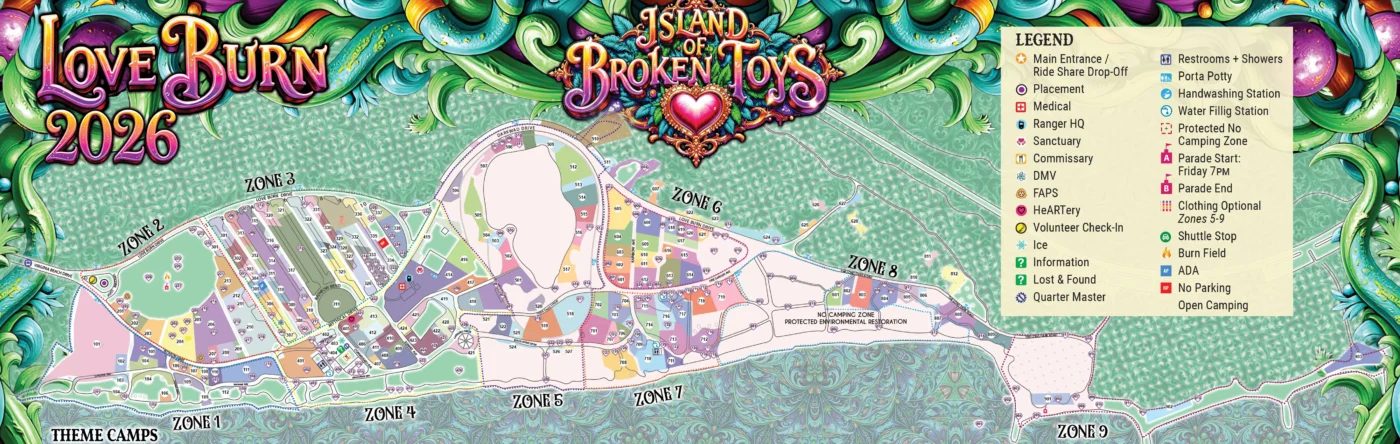
Love Burn 2026 Site Map | The Urban Grid | Image by The neighborhood grid.
The chaos of art cars and house music hums in the background, but there, at a theme camp, is routine; there is care.
Put simply, dinner parties rely on a quiet social contract. Arrive with something in hand. The host should be greeted and thanked. Help clean up, or at least don’t leave a mess. It works because everyone agrees to participate in its success.
Burning Man’s gifting culture operates on the same premise. The hospitality is not monetized, but it is not passive. It requires engagement. It requires gratitude. It requires understanding that what you are receiving is someone else’s labor, offered freely.
When no one is paying, and no one is performing for tips, the joke becomes mutual, and mutuality is where community begins.
In the absence of that hierarchy, even a deli line can feel like a living room.
The Spread
Cost of Generosity
Generosity, even radical generosity, is not weightless. Behind every plated sandwich or shucked oyster is a body that lifted the cooler, chopped the onions, scrubbed the pans; the gifting economy may remove money from the equation, but it does not remove effort. It simply redistributes the reward.
So who does the cooking?
In many camps, kitchens are led by industry professionals: chefs, caterers, and line cooks who spend their default-world lives living in that hierarchy.
For them, a burn can feel like liberation. The absence of ticket printing, reviews, and a hovering manager all bring joy back into the craft. But the skillset remains the same. The labor remains the same. Only the compensation changes.
Financially gifting has a cost. Ingredients are not donated by the desert. Sashimi does not appear by magic. Fundraisers soften the blow, and camp dues help cover infrastructure, but someone pays upfront. Someone assumes risk.
When camps become known for their offerings, reputation enters the room, and an expectation follows. What begins as spontaneous generosity can harden into obligation.
Is it still radical if it becomes anticipated?
None of this negates the beauty of the act. But it complicates it.
Generosity at scale requires organization. Organization requires leadership. Leadership requires labor. And labor, even when freely given, is still labor.
Perhaps the most radical part is not the sandwich itself, but the willingness to keep making it, knowing no one owes you applause.
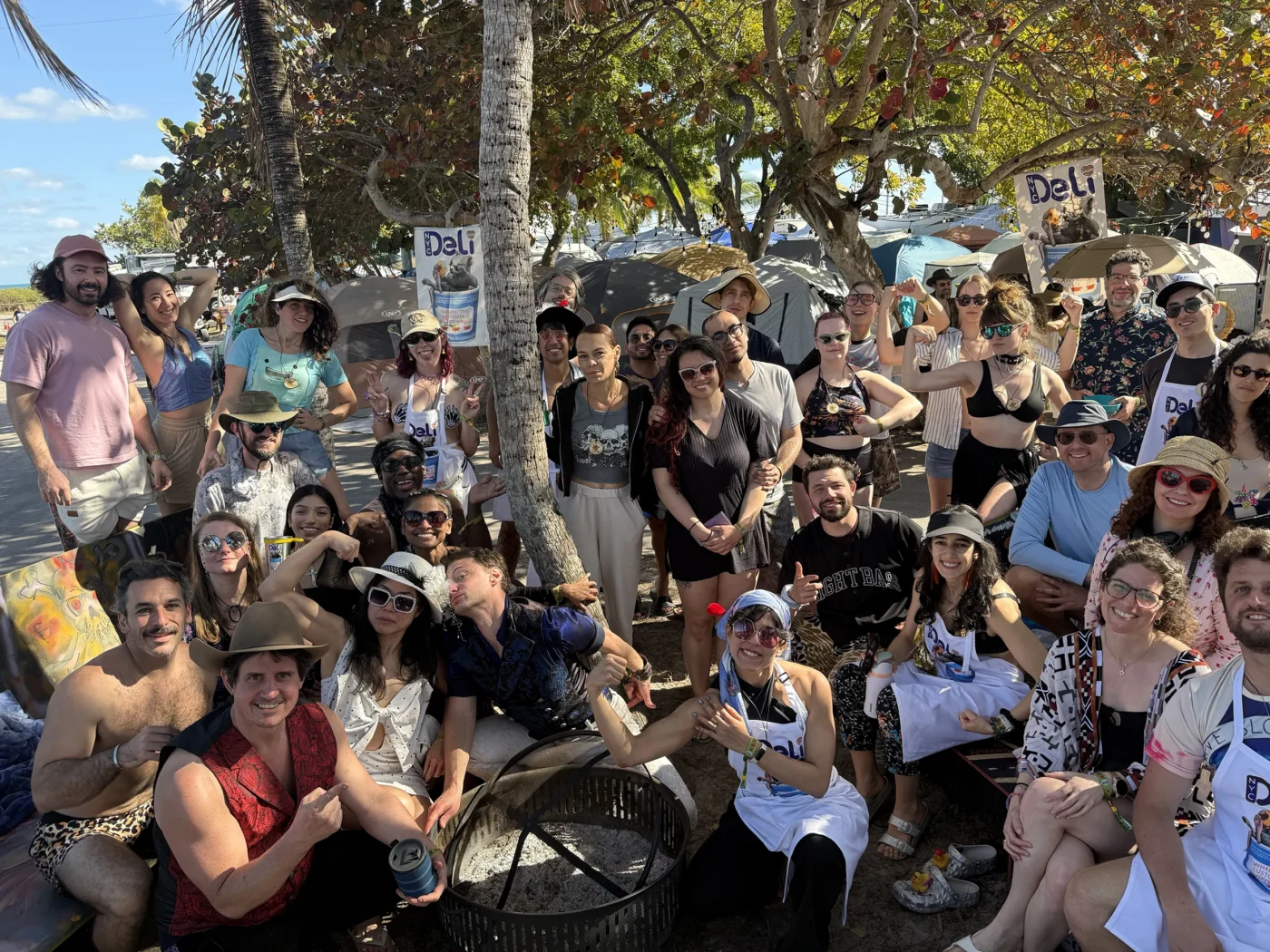
NYC Deli Camp Staff | Participation in Practice | Image by The faces of radical hospitality.

The Fresh Veggies
Participation in Practice
“Next!”
A burner steps forward, radiating sunscreen and sunburn. He scans the bread options, squints, then reaches, barehanded, for a bun.
The slap is swift.
A latex-gloved hand intercepts his.
“Absolutely not.”
The line gasps. Someone cackles.
“I will handle the bread,” the server declares, lifting her gloved hands similar to those of a surgeon about to operate.
The burner recoils, palms up in surrender. “I’m so sorry,” he says. “I didn’t realize. Please.”
“Beg for forgiveness,” another voice calls from behind the counter.
He does, rather dramatically, clasping his hands at his chest. Once he gets on his knees, the line erupts. He laughs, accepting his mock-scolding with exaggerated shame.
Mustard is smeared. Lettuce falls. The sandwich is wrapped and handed over like a prize.
He walks away grinning anyway.
From a distance, it looks like chaos, shouting, music drizzled in from the neighboring sound camp, the NYC Deli banner rattling in the wind. But up close, it feels strangely tender.
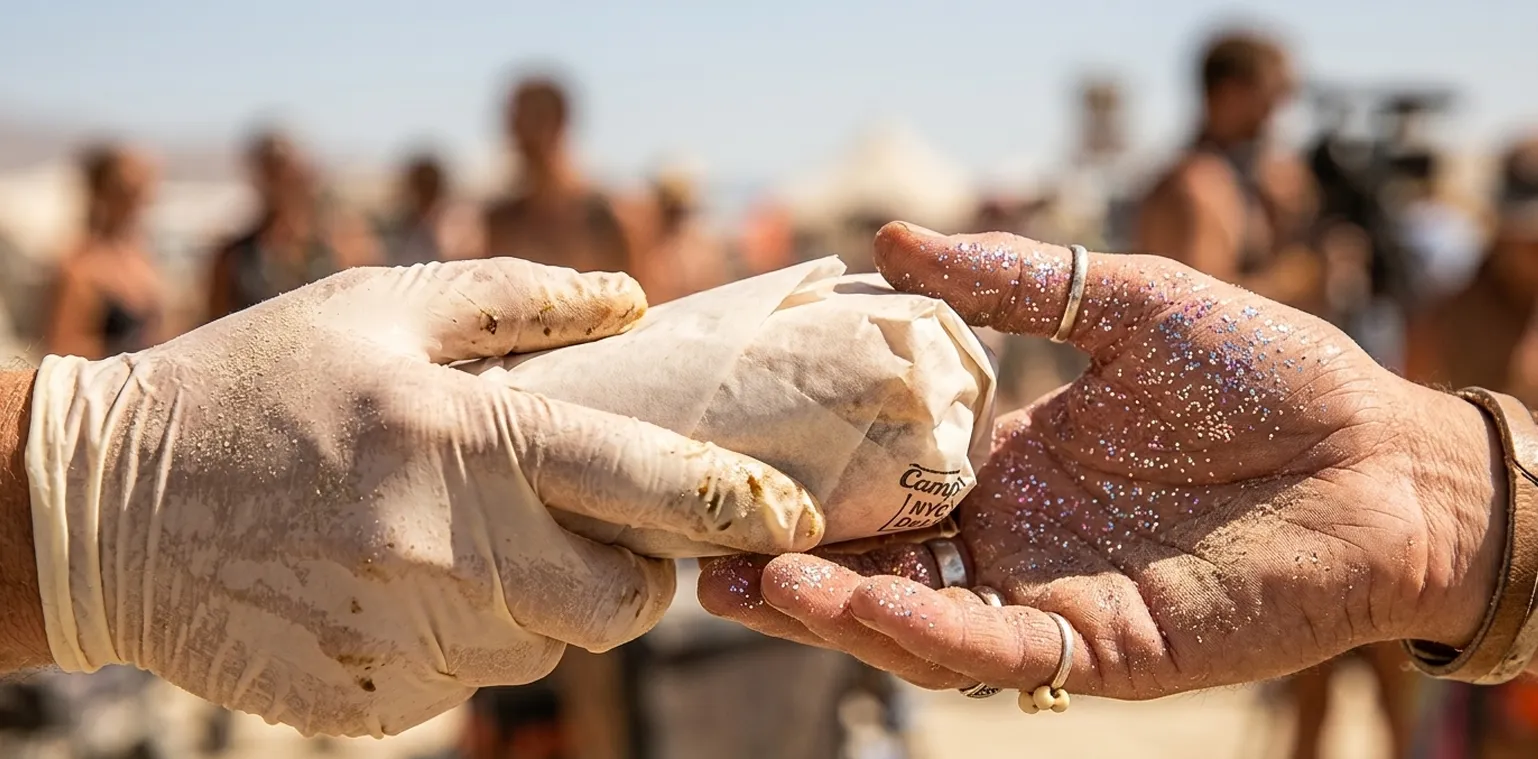
A sandwich passed hand to hand. Eye contact held. A joke shared between people who, until the city is deconstructed, agree to take care of one another.
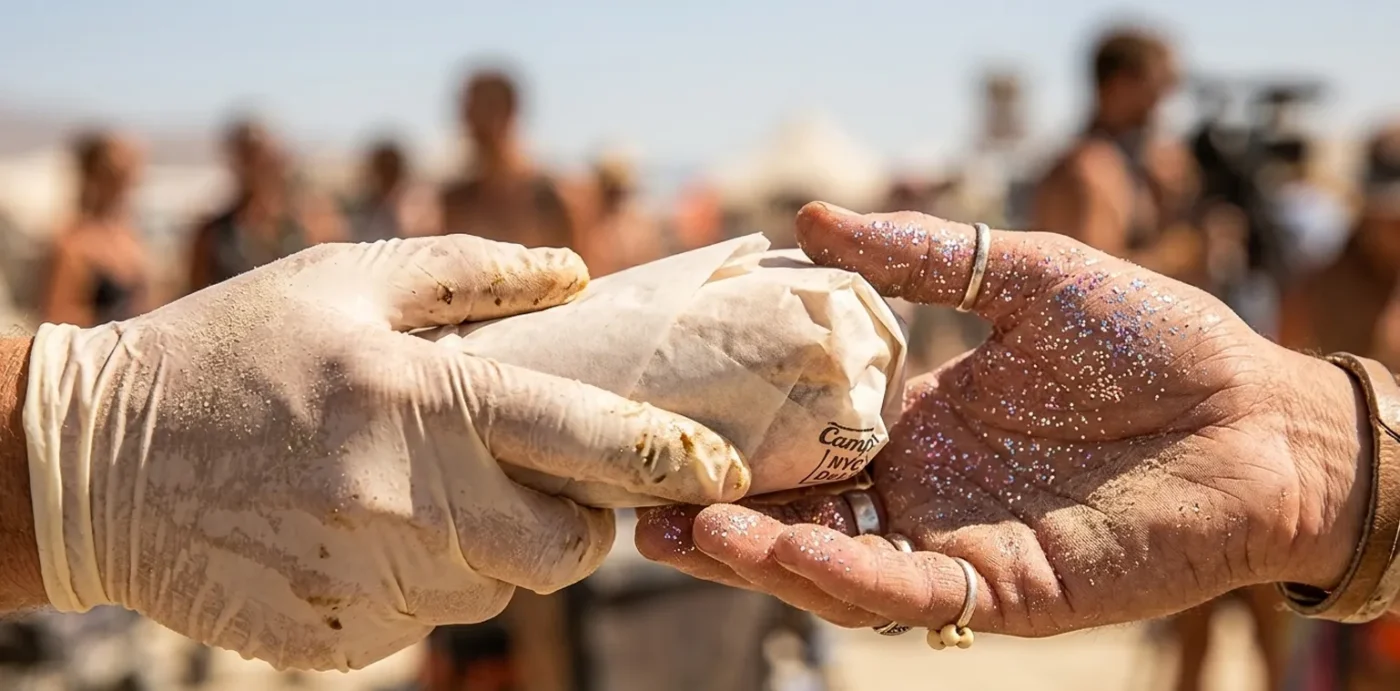
The Hand-Off | Radical Generosity in the Service Industry | Image by The Hand Off
“The customer is always wrong,”
The sign insists. But that’s because there is no customer. There are only participants. Hosts and guests trading places.
The cooks will wander off later in search of another camp’s coffee. Burners will return tomorrow to slice tomatoes instead of standing in line.
In a city devoted to radical self-reliance, perhaps the most radical act is not surviving on your own at all.
It is waking up early. It is hauling the cooler. It is yelling about onions. It is feeding someone who will not pay you back.
And trusting that, somewhere down the way, someone else will do the same.

Trending
Weighing Culinary Diplomas Against Kitchen Battle Scars
“I Was Wrong, Kinda”

No Tax on Tips: The 2026 Guide to Your $25,000 Tax Deduction
The Top 5 Cities For F&B’rs
Nuts & Napkins

Hooking Up With Coworkers

The Manager On Duty

Who is the Bitchy Waiter

Serving Philanthropy with a Side of Santo

Top 5 Cities Where F&B Pros Shouldn’t Detour